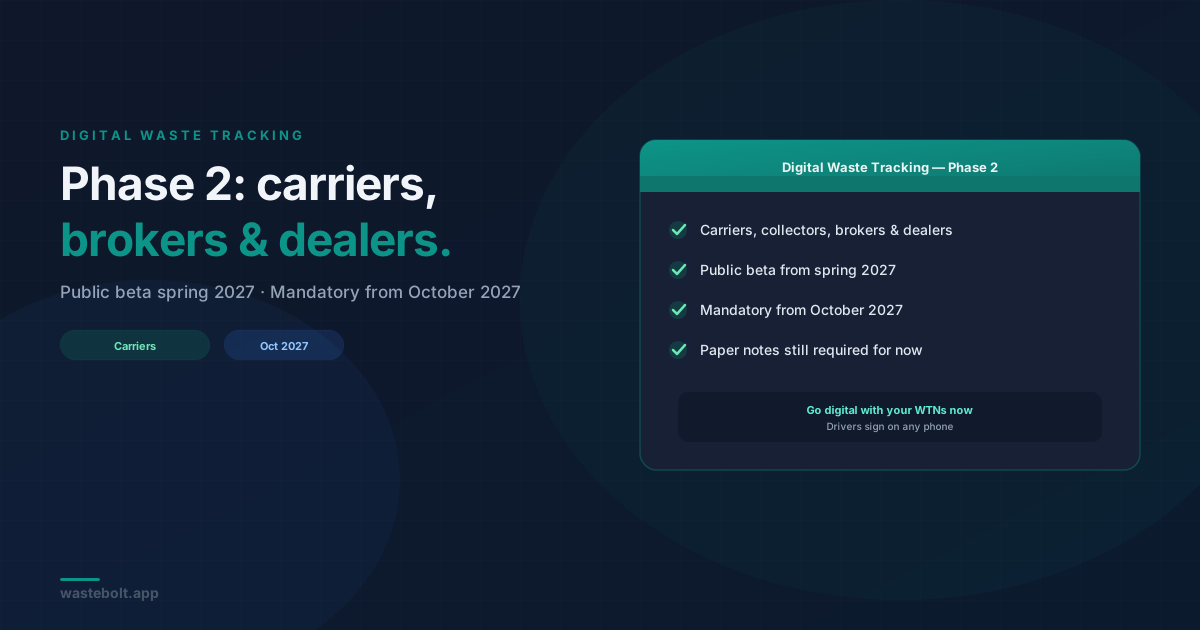
Phase 2 of Digital Waste Tracking (DWT) brings waste carriers, collectors, brokers and dealers onto the system, with mandatory use expected from October 2027. Phase 1 — waste receiving sites — is already live in England and Wales and starts in Scotland and Northern Ireland in January 2027. If you move or arrange waste for other people, phase 2 is the one that affects you directly. Here is what is confirmed, what isn’t yet, and what you can do now.
Phase 2 at a glance
| Phase 2 | |
|---|---|
| Who | Waste carriers, collectors, brokers and dealers |
| Private beta | From autumn 2026 |
| Public beta | From spring 2027 (NetRegs says April 2027) |
| Mandatory | From October 2027 |
| Scotland | Phase 2 regulations under development, expected October 2027 |
| Detailed reporting spec | Not yet published |
| Paper notes | Still required — not replaced yet |
Phase 1 vs phase 2
Phase 1 covers sites that receive waste under a permit: transfer stations, scrap yards, landfills, energy-from-waste plants, and composting and anaerobic digestion sites. Each load received has to be recorded on Defra’s Digital Waste Tracking service, usually within two working days.
| Nation | Phase 1 mandatory from |
|---|---|
| England & Wales | 1 October 2026 |
| Scotland | 1 January 2027 (Scotland guide) |
| Northern Ireland | January 2027 (Northern Ireland guide) |
Phase 2 moves further up the chain, to the businesses that collect, transport and arrange the movement of waste. That is when Digital Waste Tracking stops being something only receiving sites deal with.
Who is in scope for phase 2?
The government’s policy paper on the Digital Waste Tracking service names waste carriers, brokers and dealers, and NetRegs adds collectors. In practice that means:
- Skip hire and waste collection companies
- Hauliers moving waste between sites
- Brokers and dealers who arrange waste movements without handling the waste themselves (see digital waste tracking software for waste brokers)
Two groups are not confirmed for phase 2:
- Waste producers — businesses that create waste but don’t carry it aren’t named in any official phase 2 scope so far.
- Waste exemptions — the government says exemptions will be included “in a later phase”, without a date.
If you are a producer that also carries its own waste, keep an eye on the final guidance — that is the kind of detail the phase 2 rules will need to settle.
What will carriers have to record?
Defra hasn’t published the detailed phase 2 reporting specification yet, so nobody can tell you the exact fields today. The government’s original consultation response gives a sense of the intent: information entered before a movement starts, with the carrier and receiver updating and confirming it, within two working days.
Treat that as a direction of travel, not the final rule. The phase 2 public beta in spring 2027 is when the real detail will become clear — and when software providers, including WasteBolt, can build and test against it.
Do paper waste transfer notes go away?
Not yet. NetRegs is clear that Digital Waste Tracking does not replace existing duty of care requirements, and the Environment Agency has said it is not initially moving away from current reporting methods. You still need compliant waste transfer notes and hazardous waste consignment notes.
The long-term aim is for the digital service to replace them, but no date has been set.
What will it cost?
The annual service charge for phase 1 is currently £26. No official phase 2 fee has been announced — be wary of anyone quoting one as fact.
Phase 1 already affects carriers
Even before phase 2, carriers are feeling the effect. Receiving sites now have to submit details of every load to Defra, and much of that information comes from the carrier:
- Your waste carrier registration number — receivers need it on every record, so make sure it’s current and on your paperwork. See how to check a waste carrier registration.
- Vehicle registration — required whenever waste moves by road.
- Accurate EWC codes and descriptions — receivers can’t submit a load with a missing or malformed code.
- Consignment note codes for hazardous waste.
Carriers who already hand over complete, accurate digital notes are easier to work with today, and will find phase 2 a much smaller step.
How to prepare now
- Go digital with your waste transfer notes. Notes created and signed on a phone, with your registration number and vehicle reg filled in automatically, are already most of the way to what phase 2 will need.
- Check your carrier registration. Make sure it is valid, at the right tier, and appears on every note.
- Tidy up your EWC codes. Use the correct six-digit code for each waste stream you carry — our EWC code list makes it quick to check.
- Join the public beta when it opens in spring 2027, so you’re testing with real loads well before October.
- Talk to your receiving sites. Ask what they’re missing from your paperwork today — it’s a good preview of phase 2.
How WasteBolt helps carriers
WasteBolt is already live on Defra’s Digital Waste Tracking service for receiving sites, and we’re preparing for phase 2 alongside the public beta. For carriers today (the full picture is in our guide to digital waste tracking software for waste carriers):
- Digital waste transfer notes created and signed by drivers on their phone, with every party getting a PDF straight away
- Driver accounts on Pro and Enterprise, so each driver only sees what they need
- WasteBolt Linked, to pass notes directly to receiving sites that also use WasteBolt
- Done For You, if you’d rather our team handled the Digital Waste Tracking side for you
Frequently asked questions
When does Digital Waste Tracking phase 2 start?
Mandatory use is expected from October 2027, with a public beta from spring 2027 and a private beta from autumn 2026.
Who does phase 2 apply to?
Waste carriers, collectors, brokers and dealers. Waste producers and exemption holders haven’t been confirmed for phase 2.
Do I need to do anything before October 2027?
Nothing is mandatory for carriers yet, but receiving sites already need your registration number, vehicle registration and accurate EWC codes for their phase 1 submissions.
Will Digital Waste Tracking replace waste transfer notes?
Eventually, but not yet. Existing duty of care requirements still apply, so keep issuing compliant notes.
Does phase 2 apply in Scotland and Northern Ireland?
Yes. SEPA expects Scotland’s phase 2 regulations to come into force in October 2027, and DAERA plans the same month for Northern Ireland.
Sources
- GOV.UK: Developing the digital waste tracking service
- Environment Agency: Digital waste tracking goes live
- NetRegs: Digital waste tracking
- DAERA: Digital waste tracking
- SEPA: Digital waste tracking